

How to Choose a Commercial Fireproofing Contractor: Questions to Ask Before You Hire
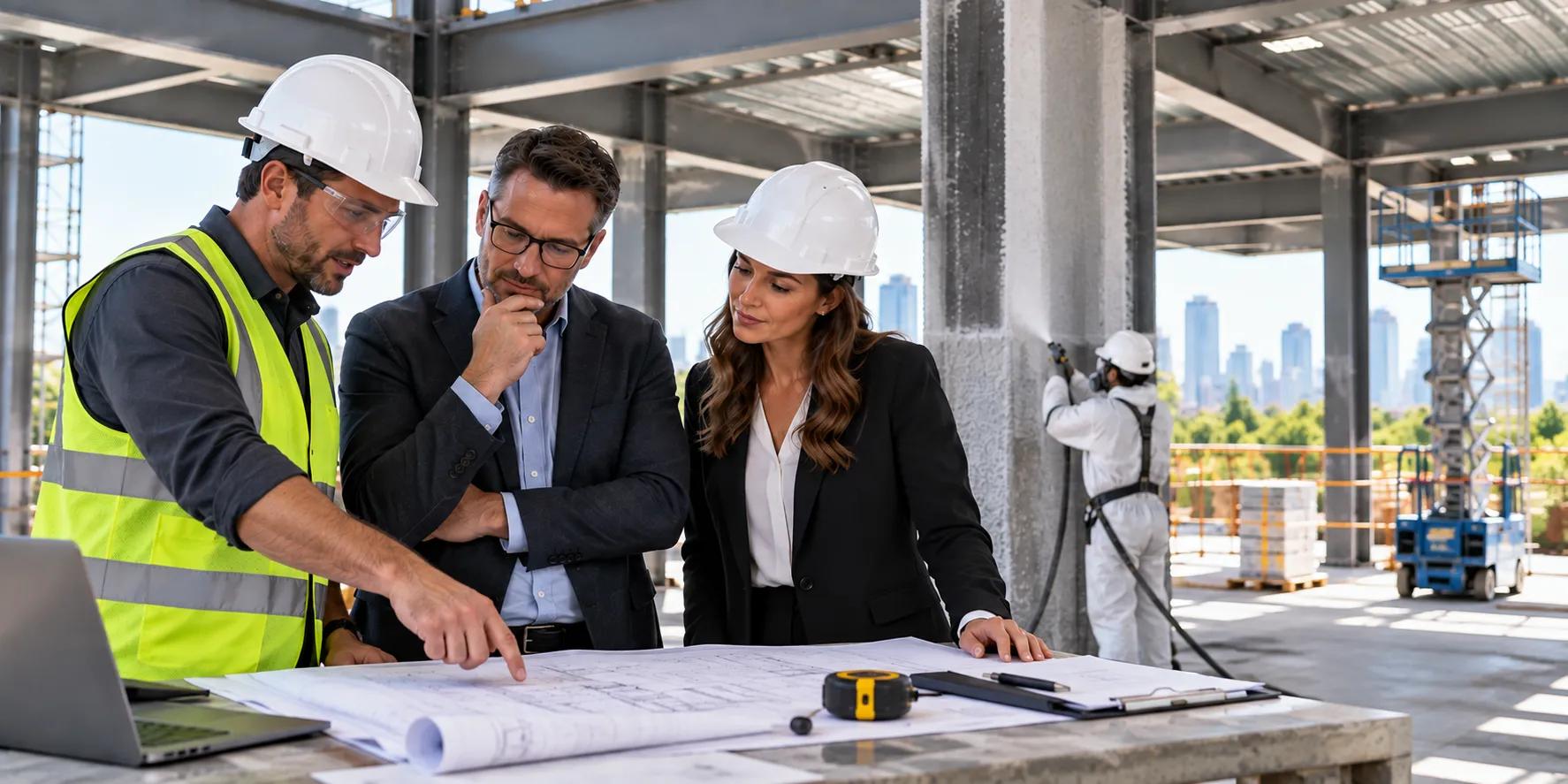
Contractor and clients reviewing fireproofing project plans
Passive fire protection is one of those systems building owners rarely think about until an inspector, insurer, or architect flags it. Unlike sprinklers or alarms, fireproofing works quietly in the background — coatings on structural steel, sealed penetrations in fire-rated walls, and barriers that contain smoke and flame long enough for people to get out safely. But because it's largely invisible once installed, choosing the right contractor matters enormously. A poorly applied intumescent coating or a badly sealed penetration can fail exactly when it's needed most, and the mistake often isn't discovered until a fire investigation or a failed code inspection.
If you're evaluating commercial fireproofing services for a new build, renovation, or compliance retrofit, here are the questions that actually separate a qualified contractor from one that just owns a spray rig.
1. How long has the contractor been doing this specific work?
Fireproofing is a specialized trade, not a general contracting add-on. Ask how long the company has focused specifically on passive fire protection, intumescent coatings, spray-applied fireproofing, firestop systems rather than treating it as one line item among many. Contractors that have operated in this niche for decades tend to have seen a wider range of building types, steel configurations, and code updates, which shows up in fewer callbacks and rework requests. Some Canadian firms, such as FJ Construction Specialities, have been operating in this space since the late 1980s, which gives a useful benchmark for what "established" looks like in this industry.
2. What certifications and product approvals do they carry?
Firestop and intumescent products are tested and rated by specific bodies — in Canada, that typically means ULC (Underwriters Laboratories of Canada) listings, and products are often installed according to manufacturer-specific assemblies that have been fire-tested to standards like CAN/ULC-S115 for firestop systems. Ask which manufacturers they're certified to install for, and whether their crews hold up-to-date training certificates. A contractor who can't name their product manufacturers or testing standards on the spot is a red flag.
3. Can they show experience across comparable building types?
Fireproofing requirements differ significantly between a warehouse, a hospital, a transit station, and a heritage building. Hospitals and long-term care facilities have stricter compartmentalization rules due to limited-mobility occupants; transit infrastructure involves working around live operations with minimal disruption; museums and galleries require protecting irreplaceable collections while limiting visual impact. Ask for project references in a building type similar to yours, not just a generic portfolio.
4. Do they perform both new installation and ongoing maintenance?
Fire barriers and coatings degrade over time — from renovations that puncture rated walls, from moisture exposure, or from simple wear. A contractor who only installs and disappears leaves you exposed at your next fire code audit. Look for one that offers inspection, repair, and fire barrier management as an ongoing service, not just a one-time job.
5. How do they handle surface preparation and quality control?
Intumescent and epoxy coatings are only as good as the steel preparation underneath them. Ask about surface prep standards (grit blasting, primer compatibility), coating thickness verification (dry film thickness testing), and whether they document this for compliance records. Reputable commercial fireproofing services will have a clear QC process they can walk you through, not just a verbal assurance that "it's fine."
6. Are they familiar with your local fire code and AHJ expectations?
Requirements can vary by municipality and by the Authority Having Jurisdiction (AHJ) reviewing your project. A contractor with a track record in your region Ontario's GTA, for instance will already understand local inspection expectations and won't need to relearn the process on your project's timeline.
Fireproofing isn't a commodity purchase. It's a life-safety system installed by people whose workmanship you'll likely never see again once drywall goes up or a topcoat is applied. Asking pointed questions about certifications, project history, and long-term maintenance capability rather than just comparing quotes is the best way to ensure the system performs when it actually matters.
FAQs
Q1. What's the difference between fireproofing and firestopping?
Fireproofing generally refers to protecting structural elements (like steel beams and columns) from heat damage, often using intumescent or spray-applied coatings. Firestopping refers to sealing openings and penetrations in fire-rated walls, floors, and ceilings such as where pipes or cables pass through to stop fire and smoke from spreading between compartments.
Q2. How do I know if a fireproofing contractor is properly certified?
Ask which manufacturers they're certified to install products for, and whether their installations follow tested assemblies rated to standards like CAN/ULC-S115 (for firestop systems) in Canada. A qualified contractor should be able to name these credentials without hesitation.
Q3. How often should fire barriers and firestopping be inspected?
There's no single universal interval — it depends on local code requirements, building type, and how frequently renovations or trade work disturb rated assemblies. Facility managers typically schedule inspections as part of routine fire safety audits, and after any construction activity that penetrates rated walls or ceilings.
Q4. Does intumescent coating affect a building's appearance?
Not significantly. Intumescent coatings are thin, paint-like applications that sit close to the surface of the steel and can typically be top-coated to match architectural finishes, which is why they're often used in visible areas like lobbies and exposed structural steel.
Q5. Is fireproofing a one-time installation, or does it require maintenance?
Fireproofing systems can degrade over time due to renovations, moisture exposure, or wear, so many contractors offer ongoing fire barrier management inspection, repair, and compliance documentation — rather than treating installation as a single, final step.
Q6. What building types have the strictest fireproofing requirements?
Occupancies with vulnerable or high-density populations hospitals, long-term care facilities, and transit stations — tend to have stricter compartmentalization and fire-resistance requirements than typical commercial office space, due to evacuation challenges and higher life-safety risk.