

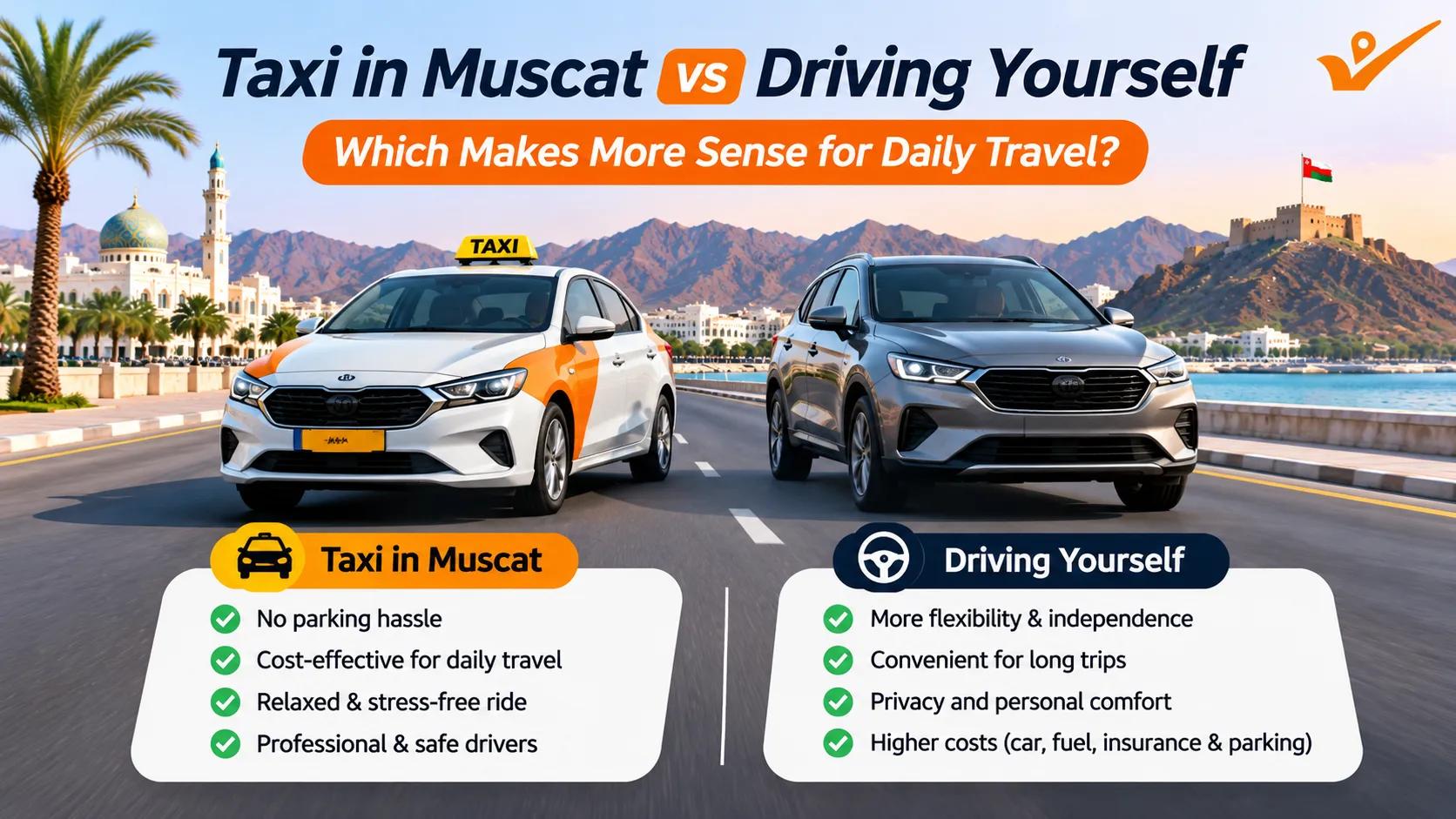

It is one of the first decisions every new resident in Muscat faces and one that long-term residents occasionally revisit when their circumstances change. Do you buy a car, maintain it, insure it, fuel it, and navigate Muscat's roads every morning and evening? Or do you rely on taxis and app-based transport to move around a city that, by most measures, was designed with drivers in mind?
There is no universal answer. The right choice depends on where you live, where you work, how often you travel, what you earn, and how much value you place on your time versus your money. But there are clear patterns that emerge when you work through the comparison honestly, and for a significant number of Muscat's residents, those patterns point in a direction that surprises them.
The True Cost of Owning and Running a Car in Muscat
The sticker price of a car is the number most people think about first. But the monthly cost of car ownership in Muscat is considerably higher than the purchase price divided by the number of months financed, and it is worth working through the full picture before assuming ownership is automatically the more economical option.
Purchase cost and depreciation. A new mid-range family sedan in Oman typically starts from around 7,000 to 10,000 Omani Rials. Depreciation on new vehicles in the Gulf runs at roughly 15 to 20 percent in the first year alone, which means a significant portion of that purchase price is absorbed before the car has covered its first 10,000 kilometres.
Insurance. Comprehensive car insurance in Oman for a new driver or a younger resident can run from 200 to 400 OMR annually depending on the vehicle, the driver's history, and the insurer. Third-party only coverage is cheaper but leaves the vehicle itself unprotected.
Fuel. Fuel prices in Oman are among the more affordable in the region, but a car driven daily across Muscat's distances, which can easily cover 40 to 60 kilometres per day for a standard commute between residential and commercial districts, accumulates a monthly fuel bill that adds meaningfully to the running cost.
Maintenance and servicing. Tyres, oil changes, brake pads, air conditioning servicing in a climate where the AC runs almost continuously for six months of the year, and the unexpected repairs that accompany any vehicle driven daily in stop-start traffic across varied road surfaces. These costs are irregular and therefore easy to underestimate when calculating monthly transport spend.
Parking. In Muscat's busier commercial and dining districts, parking availability is not always guaranteed and paid parking is becoming increasingly common. The time spent searching for parking, particularly around Qurum, MQ, and Al Khuwair, has a cost in stress and minutes that does not appear on any receipt.
Registration and administration. Annual vehicle registration, occasional traffic fines, and the administrative time associated with managing a vehicle all form part of the true cost of ownership that rarely features in the initial calculation.
When all of these costs are added together, the realistic monthly cost of running a mid-range car in Muscat, accounting for depreciation, insurance, fuel, and maintenance, typically falls between 200 and 350 OMR per month depending on the vehicle and driving habits. For residents who commute relatively short distances or who work in areas with reliable taxi availability, this number is worth comparing directly against a realistic monthly taxi spend.
The Real Cost of Using Taxis Daily in Muscat
The honest calculation here requires knowing what your actual regular journeys cost rather than estimating vaguely.
If a resident in Azaiba commutes daily to Al Khuwair, a distance of roughly eight to ten kilometres each way, and books a taxi in muscat using a platform that charges a published per-kilometre rate on a fixed-fare basis, the cost per journey is calculable in advance rather than approximate. At a base fare of 1 OMR covering the first five kilometres and 130 to 170 baisas per additional kilometre depending on the vehicle category chosen, a ten-kilometre journey falls in the range of 1.65 to 1.85 OMR.
Two journeys per day at that rate, across a standard working month of 22 days, produces a monthly commute cost of approximately 72 to 81 OMR for a standard category vehicle. Add occasional evening outings, weekend trips, and airport runs, and a realistic monthly taxi spend for a Muscat resident without a car might land somewhere between 100 and 150 OMR per month, depending on lifestyle and journey frequency.
Against a car ownership cost of 200 to 350 OMR per month, that comparison is striking. Even accounting for the convenience of having a vehicle available at any moment without booking, the financial case for relying on taxis is stronger than most residents expect before they sit down and do the maths.
Where Driving Yourself Makes More Sense
The financial comparison does not tell the whole story. There are genuine situations where owning and driving a car in Muscat is the more practical choice.
Families with children and complex logistics. A household managing school runs, extracurricular activities, grocery shopping, and multiple simultaneous journeys in different directions is difficult to coordinate through taxi bookings alone. The flexibility of having a vehicle available at all times without the need to book, wait, or coordinate with a driver matters significantly when schedules are unpredictable and multiple family members need to be in different places at the same time.
Residents in areas with lower taxi availability. Muscat's residential spread means that some wilayats and newer developments sit at distances from commercial hubs where taxi response times are longer and availability during off-peak hours is less reliable. For residents in these areas, car ownership offers a reliability that on-demand taxi platforms cannot always match.
Professionals who travel frequently between sites. A sales representative visiting multiple clients across Muscat in a single day, or a tradesperson moving between job sites with tools and equipment, needs the kind of continuous, flexible mobility that a personal vehicle provides and a series of individual taxi bookings cannot replicate cost-effectively.
Those who value spontaneity. The ability to leave at any moment, take an unplanned detour, or change destination mid-journey without coordinating with a driver has a real value that is difficult to quantify but genuinely important to some residents' daily experience.
Where Taxis Make More Sense
Single professionals and couples without children. The simplest household transport needs, commuting, dining out, weekend activities, and occasional airport runs, map well onto what app-based taxi platforms offer. The financial saving against car ownership is substantial and the inconvenience is limited.
Newly arrived expats. Navigating an unfamiliar road network in a new country while managing all the other adjustments of relocation is stressful. Spending six to twelve months using taxis while learning the city, building local knowledge, and deciding which residential area and lifestyle genuinely suits you before committing to a vehicle purchase is a financially and practically sensible default.
Visitors and short to medium-term residents. Anyone spending fewer than twelve months in Muscat is unlikely to recover the depreciation, insurance, and administrative costs of vehicle ownership before they leave. The maths of taxi use versus car ownership shifts decisively toward taxis for this group.
Those who commute to accessible commercial areas. Residents whose commute takes them to Al Khuwair, Qurum, Bausher, or Muscat's main commercial districts, all well-served by app-based platforms, have the most to gain from taxi travel both financially and in terms of avoiding the parking search that accompanies driving to busy areas.
The Variable That Changes the Calculation Most
The single factor that has the most impact on whether taxis make financial sense for daily travel in Muscat is the predictability and transparency of the fare. A platform that quotes a fixed fare and sticks to it makes the monthly calculation possible. A platform that uses metered or surge-based pricing makes it approximate at best, which reintroduces exactly the kind of uncertainty that makes budgeting around taxis feel unreliable.
This is where the choice of platform matters as much as the choice of transport mode. Taxi Muscat operates on fixed, published per-kilometre rates across four vehicle categories, which means a daily commuter can calculate their exact monthly taxi spend before the month begins rather than estimating it after the fact. That predictability is the practical foundation that makes the decision to go car-free in Muscat financially viable rather than merely theoretically attractive.
Before committing to either option, the most useful exercise is a straightforward one. Write down your ten most common journeys in a typical month. Calculate the taxi cost for each using a platform with published per-kilometre rates. Multiply by their frequency. Then compare that total against the realistic monthly cost of vehicle ownership, including depreciation, insurance, fuel, maintenance, and parking.
For a significant number of Muscat residents, particularly single professionals, newly arrived expats, and anyone whose primary journeys run between well-served commercial and residential districts, that comparison produces a result that challenges the assumption that owning a car is automatically the practical and financial default.
A taxi in oman context where platforms publish rates, offer multiple vehicle categories, and operate around the clock means that the case for going car-free or car-light in Muscat has never been stronger than it is right now. The question is not whether the option exists. It is whether you have done the maths to know if it works for your specific situation.